Weekly Reads
A space where we share a selection of thought-provoking content that we've recently come across.
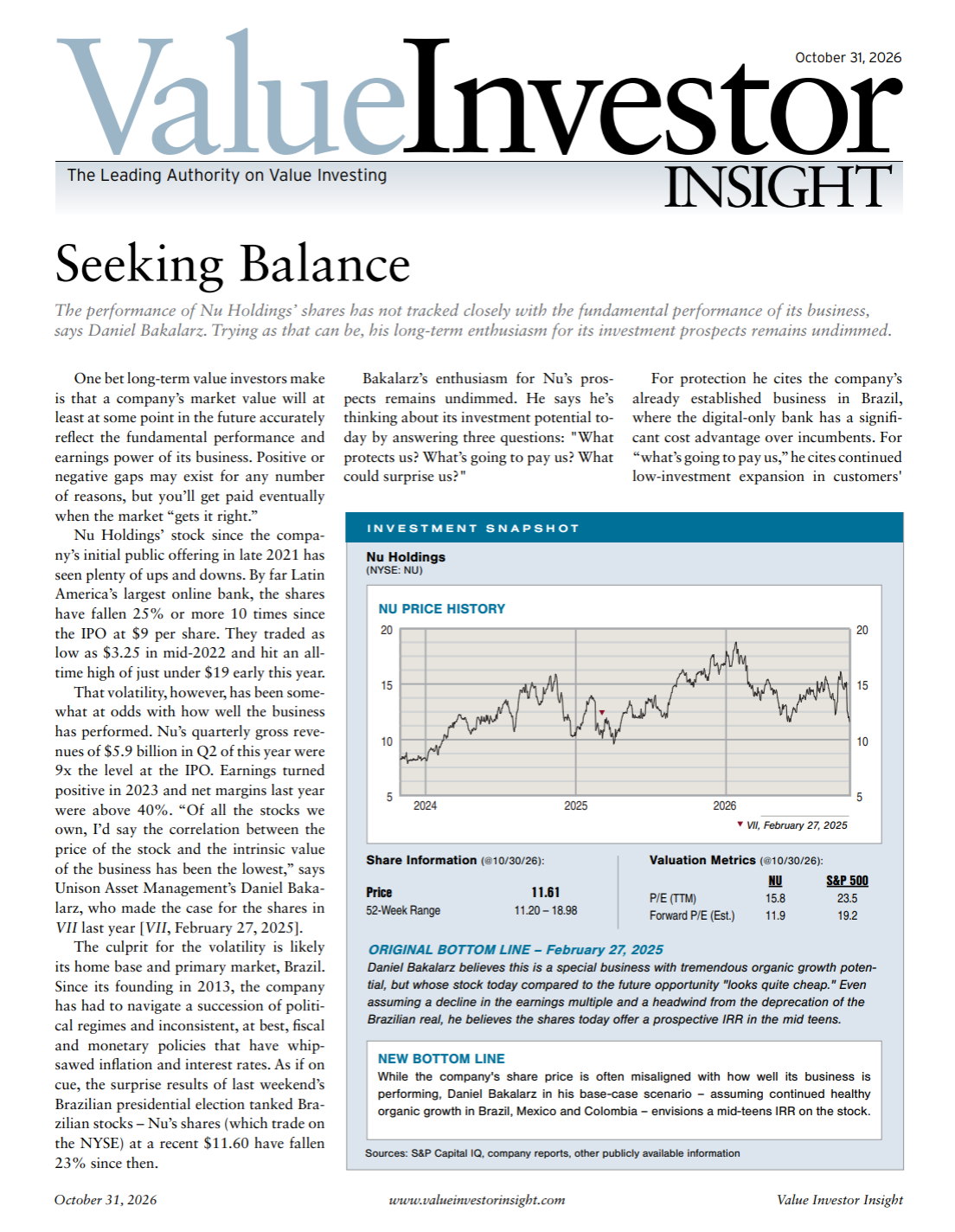
Value Investor Insight: Seeking BalanceTwenty months after our first Value Investor Insight feature, our Co-CIO Daniel Bakalarz returned to discuss Nu Holdings. The stock has been volatile, but our conviction hasn’t moved. Dan walks through the three questions we ask of every investment: What protects us? What’s going to pay us? What could surprise us?
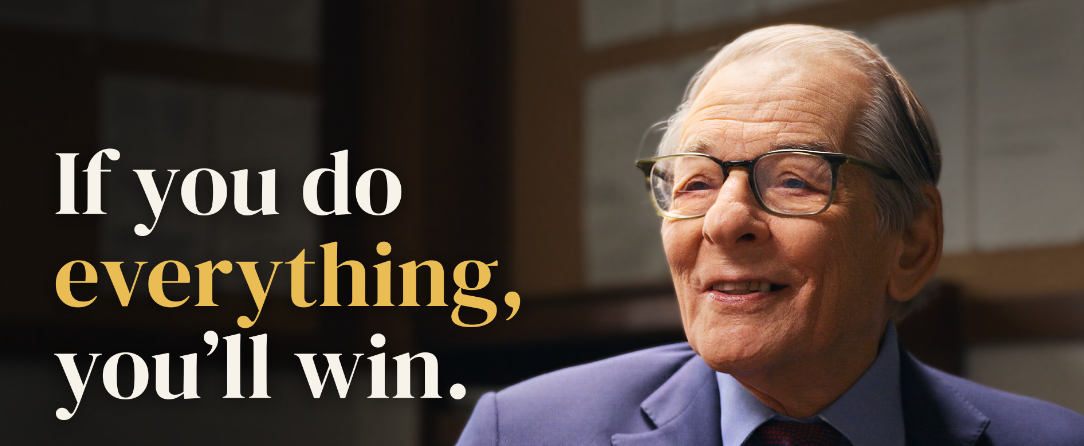
Robert Caro sits down with Dwarkesh Patel to discuss what 50 years studying Lyndon Johnson and Robert Moses taught him about power. His central argument is that persuasion is never the real source of power: when Johnson leaned into a senator, the force behind it was his control over committee assignments and legislation, just as Moses’s power rested on a web of interlocking, hard-to-revoke public authorities. Both men were ruthless, but power transformed Moses most: an idealistic reformer became a man who evicted tens of thousands to build the Cross Bronx Expressway and destroyed opponents by exploiting their weaknesses, all without recognizing how much he had changed. Circumstance mattered too: the Depression gave Moses a glut of cheap labor, and he was unfireable for decades until age let Rockefeller call his resignation bluff in 1962. On today’s building gridlock, Caro notes people said the same in Moses’s era and expects a political genius to eventually emerge. He also describes forcing each book down to one sentence, cutting 350,000 words from The Power Broker, and donating his notes to the New-York Historical Society.
China has built the world’s largest navy, with a battle force of more than 400 ships and submarines, roughly 35% larger than the U.S. Navy by hull count, in one of the largest peacetime naval buildups in modern history. The buildup rests on shipbuilding dominance: Chinese yards produce 52.6% of the world’s cargo ships by gross tonnage versus 0.01% for the U.S., and they use that scale to build warships quickly, adding 71 major warships and submarines since 2020. The WSJ ties the push to Xi Jinping’s belief that great powers are maritime powers. China now operates three aircraft carriers, including the electromagnetic-catapult Fujian, and the Pentagon projects nine by 2035 versus the U.S. fleet of 11. Its yards have also begun producing a new, likely nuclear-powered submarine class. The core mission remains dominating the waters inside the first island chain to absorb Taiwan and keep U.S. forces out, backed by a coast guard, fishing militia, and Rocket Force, while the U.S. fleet of roughly 290 ships is no larger than in 2003 despite a doubled shipbuilding budget.

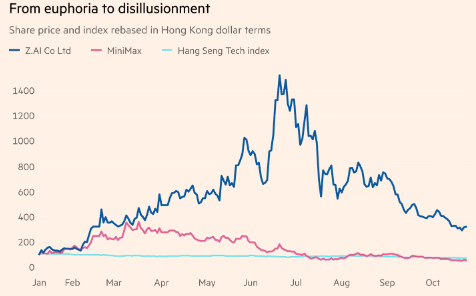
This FT Unhedged piece argues that China’s AI boom has already come and gone in miniature, while Chinese government bonds look like an underrated diversifier. Z.ai and MiniMax listed in Hong Kong in January as pure plays on frontier model makers, then fell sharply: MiniMax is 50% below its IPO price, and Z.ai shed 63% in under a month after its June peak (still up 318% year to date). Chinese labs give away open-weight models and charge for processing power, creating price competition that questions whether AI revenues can fund the required investment. The Hang Seng Tech index is down 30% year to date, and Chinese equities have fallen ten straight weeks, a first. In contrast, Chinese government bonds are the only major bonds to have beaten US inflation in dollar terms since 2020. The 10-year yield is 1.6%, the spread over Treasuries is a record 3.3 points, and foreign ownership is under 5%. That low ownership and capital controls give CGBs low volatility and limited correlation with other assets, making them worth a look for diversification.
The Eagles built one of the NFL’s best rosters by pushing salary-cap costs into the future through void years, dummy years added to the end of contracts that spread signing-bonus charges over more seasons (a $30M bonus on a two-year deal costs $10M a year over three instead of $15M over two). The tactic also exploits the rising cap ($301M this year), which makes future hits cheaper in relative terms. It fueled five straight playoff berths, two Super Bowl appearances, and one title, but Philadelphia now has over $507M in void money from 2027 to 2032, roughly twice any other team, including over $200M of dead money in 2029 alone. Jalen Hurts counts about $98M against the 2029 cap even though he is under contract only through 2028. Owner Jeffrey Lurie defends it as planning ahead to win big, but strain is showing: the Eagles are 2-5 with Hurts likely out, delayed the A.J. Brown trade over cap implications, and are keeping the retired Lane Johnson on the roster to avoid accelerating his cap hit.

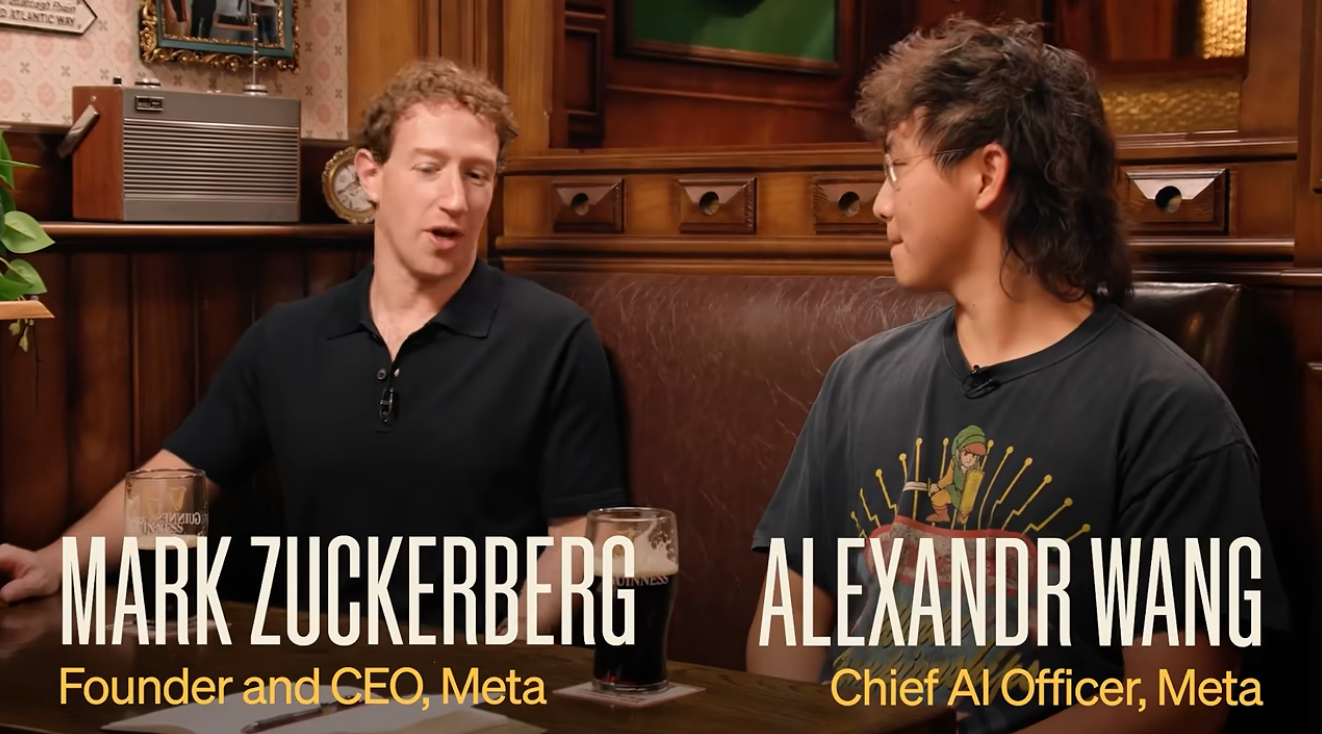
In this Cheeky Pint episode, John Collison interviews Mark Zuckerberg and Alexandr Wang about Meta’s $100bn-plus AI infrastructure bets, Meta Superintelligence Labs (MSL), and the Muse Wonder model family. Their core argument is that the model is the product: personality, proactivity, discretion, and reliability are baked into post-training rather than handled by interface design. Muse Wonder (plus a higher-tier Wonder Full) adds integrated memory across days to months, stronger persistence on long tasks, state-of-the-art finance, legal, and health evals, and top-tier coding scores. A 1-gigawatt cluster costs roughly $15bn a year to operate, with the Ohio and Louisiana clusters costing tens of billions upfront. Zuckerberg frames the risk in power-law terms: winning a platform shift must pay off enough to justify the burn, and compute retains alternative value. They expect agentic commerce to expand the addressable market by cutting transaction friction, citing Zuckerberg’s Muse-triggered weekly Instacart orders. MSL runs as a team of under 200 researchers with massive compute per head, avoiding “peanut-buttering” resources across projects.