Weekly Reads
A space where we share a selection of thought-provoking content that we've recently come across.
What's Up With Private Credit?
Investors are significantly scrutinizing the ratings of private credit held by insurance companies due to potential systemic risks. Private equity-linked insurers have accelerated their use of Private Letter Ratings (PLRs), which has spurred explosive growth among smaller credit rating agencies, causing concerns of credit quality inflation. At least 5 of the top 10 insurers holding private letter ratings are owned by Private Equity or Private Credit. A retracted report from the National Association of Insurance Commissioners (NAIC) revealed that ratings assigned via PLRs were, on average, 2.74 notches higher than the NAIC's own assessments, with four-fifths of re-rated securities receiving an upgrade, some by six or more notches, primarily from smaller firms. The IMF has flagged this widespread misclassification of risk, warning that such over-optimistic valuations could leave insurers dangerously undercapitalized, leading to significant losses and liquidity issues during a downturn.

The Future of Amazon: Automated Robots
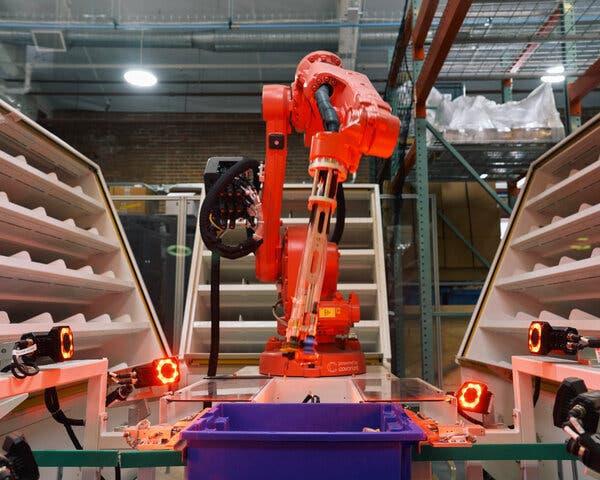
Amazon is aggressively automating its logistics process to reduce costs by minimizing human labor, contributing to the ~600,000 planned job cuts. The strategy, which spans six key areas (movement, manipulation, sorting, storage, identification, and packing), is built around sophisticated systems like Sequoia (storage) and an array of robotic arms, including Sparrow, Robin, and Cardinal. These systems now handle most fulfillment steps at Amazon's advanced facilities, with employees primarily focused on tasks like "decanting" (unpacking boxes). Critically, Amazon is dedicating significant resources to achieving "near lights-out automation" in its high-speed, same-day delivery hubs to boost profitability on low-margin items. This entire operational leap is powered by integrating Advanced AI, signaling a fundamental shift in the company's cost structure and future labor needs.
America's Perpetual Debt Burden
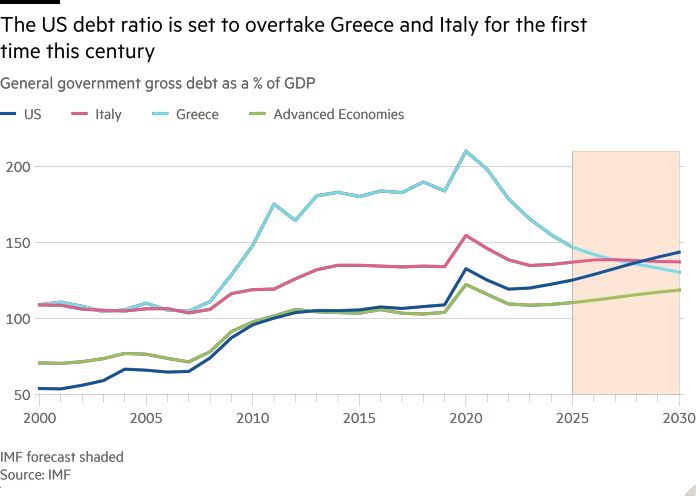
US government debt is on track to surpass the debt-to-GDP ratios of Italy and Greece for the first time this century. The IMF forecasts that US gross general government debt will climb over 20 percentage points to reach 143.4% of GDP by 2030, a ratio that is projected to still be rising afterward. This is driven by the US budget deficit, which is forecast to remain above 7% of GDP annually until 2030, the highest among rich nations. While the US benefits from having the global reserve currency, giving it greater borrowing capacity, it raises serious concerns about the sustainability of America's perpetual deficits, which are sustained by political gridlock where neither party wants to cut spending. With the US debt burden being a continuous issue, the US government has to find a long-term solution like accelerating GDP growth, increasing taxes, reducing fiscal spending, or a combination of the three.
Digital Ghosts: Agentic AI is Still Decades Away
Andrej Karpathy, a prominent figure in the AI community and former Director of AI at Tesla and founding member of OpenAI, offers an insightful look at the current limitations and future direction of large language models (LLMs) as well as the quest for Artificial General Intelligence (AGI). Karpathy contends that we are in the "decade of agents," not the year, projecting that solving the current bottlenecks in continual learning and multimodality will take about ten years. He argues that current LLMs are not "animals" (biologically evolved) but rather "ghosts," or purely digital, spirit-like entities, and emphasizes a practical approach focused on building useful tools. From an architectural standpoint, he sees the future involving convergence toward biological "cognitive tricks," such as more elaborate sparse attention schemes to achieve much longer context windows. Finally, in a compelling thought for investors, he predicts that AGI will not result in a sudden, catastrophic change, but will rather blend into the existing trend of 2% GDP growth driven by automation that has been ongoing for centuries.

America vs China: The Battle for Global Dominance
Dan Wang, a technology analyst and author who spent six years studying China's manufacturing ecosystem, claims China holds a decisive, self-sustaining advantage in the global technological race due to its vast, sophisticated manufacturing capacity, which is far harder for the U.S. to replicate than it is for China to improve its own scientific research. Wang frames China as a "high-agency society" that executes industrial projects relentlessly, serving as the "prairie fire" that scales and perfects Western inventions. This high-agency is exemplified by the country's intensive "996" work culture (9 am to 9 pm, 6 days a week), which drastically differs from the U.S., which has had a traditional 9 to 5 work culture. For investors, this creates the "ByteDance problem," where exceptional Chinese companies are forced to trade at a massive discount due to the regulatory and policy risks surrounding the Chinese government and its tendency for intervention in the market (e.g., policy changes like Zero-COVID, as well as structural regulations like antitrust and data rules), and geopolitical risks. Wang warns that the U.S. has developed a complacency that prioritizes invention over industrial scale-up, and he advises American leaders to stop merely citing a "Sputnik moment" and start treating technology and manufacturing as a serious political and economic project.